

Stretch Ceiling vs Drywall – Which Ceiling Is Better?
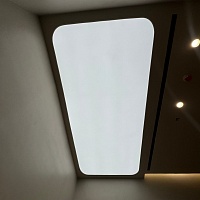
Stretch ceiling vs drywall: which solution is better? Discover the differences in design, installation, lighting integration, maintenance and creative possibilities, with real stretch ceiling projects completed in the UAE.
When designing a ceiling for a villa, apartment or commercial interior, one of the common questions is whether to use a stretch ceiling or drywall.
Both systems can create modern architectural ceilings, but they work in completely different ways.
Drywall is primarily a construction system. It is ideal for creating suspended levels, bulkheads, recesses, curtain pockets and architectural structures.
A stretch ceiling is a lightweight membrane installed within a perimeter profile. The membrane becomes the finished visible surface and can be matt, satin, glossy, translucent or integrated with lighting and fiber optics.
The important point is that stretch ceiling and drywall do not necessarily compete with each other.
In many high-end interiors, the best result is achieved by combining both systems.
What Is a Drywall Ceiling?
A drywall ceiling is normally constructed from gypsum boards mounted onto a metal framing system.
Once the boards are installed, the joints and fixing points must be finished before the surface can be painted.
Drywall is particularly useful for creating architectural elements such as recessed ceilings, different ceiling levels, bulkheads and lighting coves.
It is therefore an excellent material for constructing the architecture of the ceiling.
However, when the design requires unusual finishes, large luminous surfaces, fiber optic stars or highly decorative features, additional technologies are often required.
This is where stretch ceiling systems become particularly interesting.
A stretch ceiling uses a lightweight membrane tensioned within profiles installed around the ceiling perimeter or around a specific architectural feature.
Unlike drywall, the membrane itself becomes the final visible surface.
There is no need to plaster, sand and paint the membrane.
Depending on the design, stretch ceilings can be produced using:
Matt membranes for a clean, minimal appearance.
Satin membranes for a subtle and refined surface.
Glossy membranes for highly reflective ceiling features.
Translucent membranes for illuminated ceilings.
Black membranes for dramatic architectural or fiber optic ceilings.
White membranes for contemporary minimalist interiors.
The same technology can also be combined with LED lighting, fiber optics and custom profiles to create much more complex ceiling features.
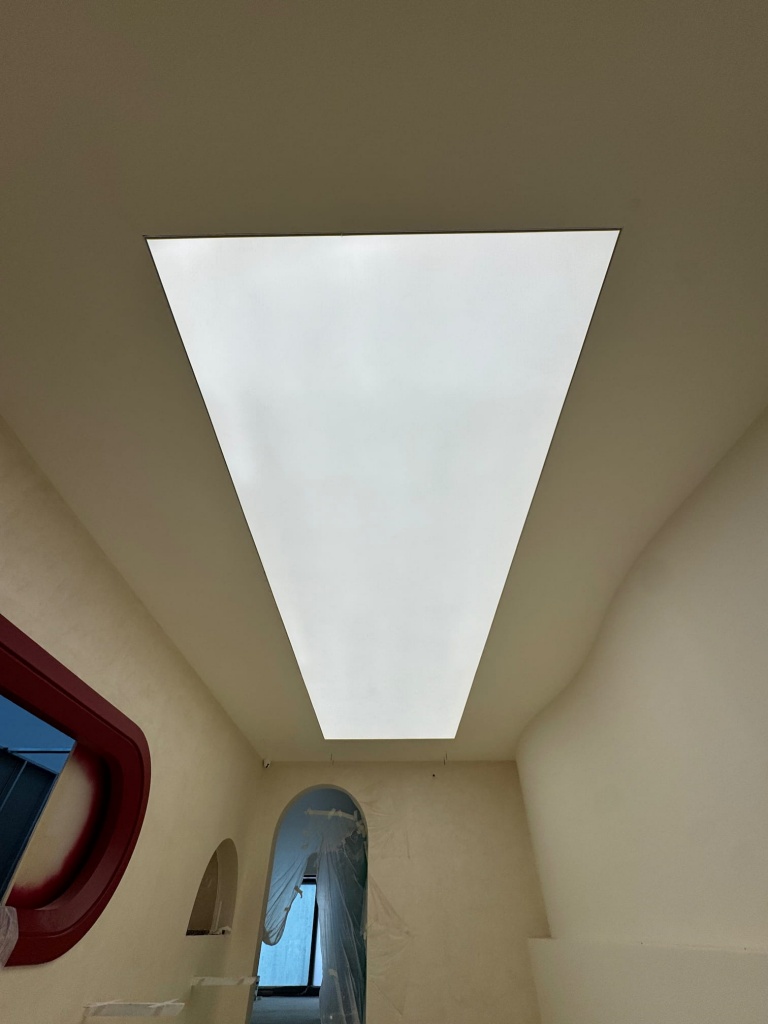
Stretch Ceiling vs Drywall – Surface Finish
One of the biggest differences is the way the final surface is produced.
With drywall, the finished appearance depends on several stages: installation of gypsum boards, treatment of joints, sanding, primer and painting.
The quality of each stage affects the final result.
Strong daylight and architectural lighting can make imperfections in a painted surface particularly noticeable.
A stretch ceiling works differently.
The membrane is manufactured as the finished surface and tensioned across the ceiling structure.
This produces a smooth and consistent appearance without plastered joints across the membrane.
For large minimalist ceilings, this can be an important advantage.
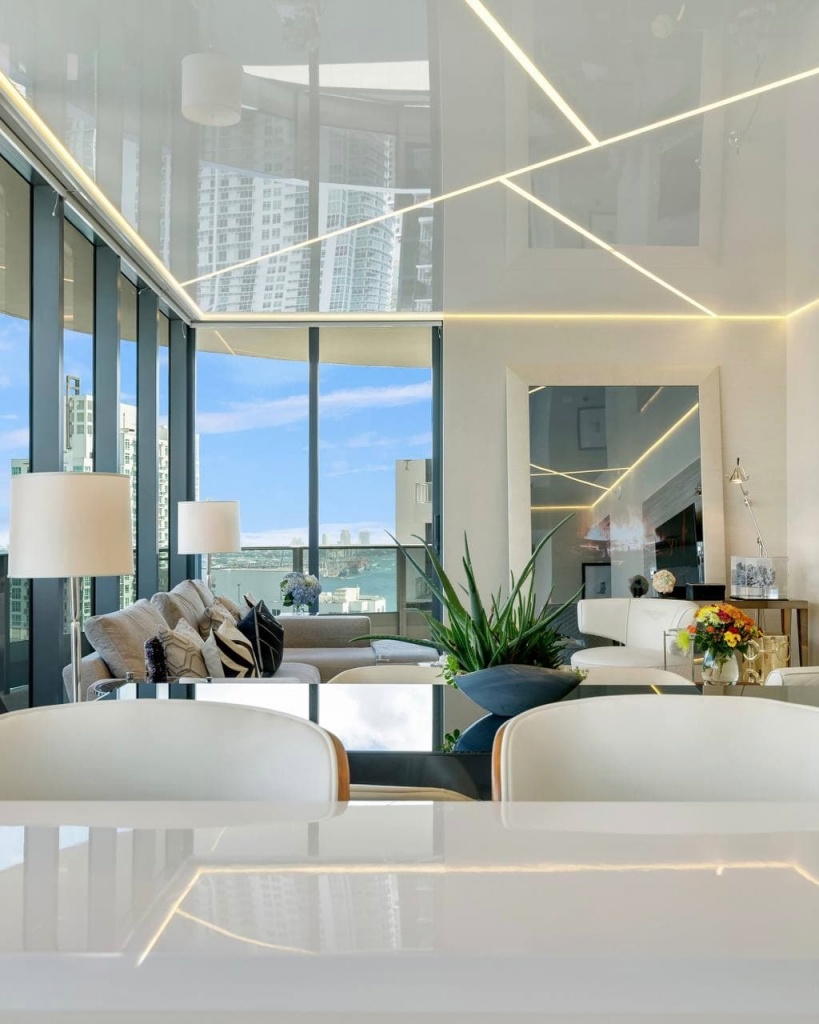
Drywall construction normally involves several trades and finishing stages.
After installation of the metal framework and gypsum boards, the ceiling requires joint treatment, sanding and painting.
Stretch ceiling installation is different.
Profiles are installed first, lighting and other technical components are prepared, and the membrane is then tensioned into position.
Because the membrane is already the finished surface, it does not require conventional plastering and painting.
This can be particularly useful during the final stages of interior fit-out or renovation.
Lighting is where the difference between the two systems becomes much more significant.
Drywall works extremely well with conventional architectural lighting.
Downlights, linear lights, chandeliers, track lighting and indirect LED coves can all be incorporated into drywall ceilings.
Stretch ceiling technology provides another possibility:
the ceiling surface itself can become the light source.
By installing LED lighting behind a translucent membrane, it is possible to create a large illuminated surface rather than a collection of individual fixtures.
This is known as a translucent stretch light ceiling.
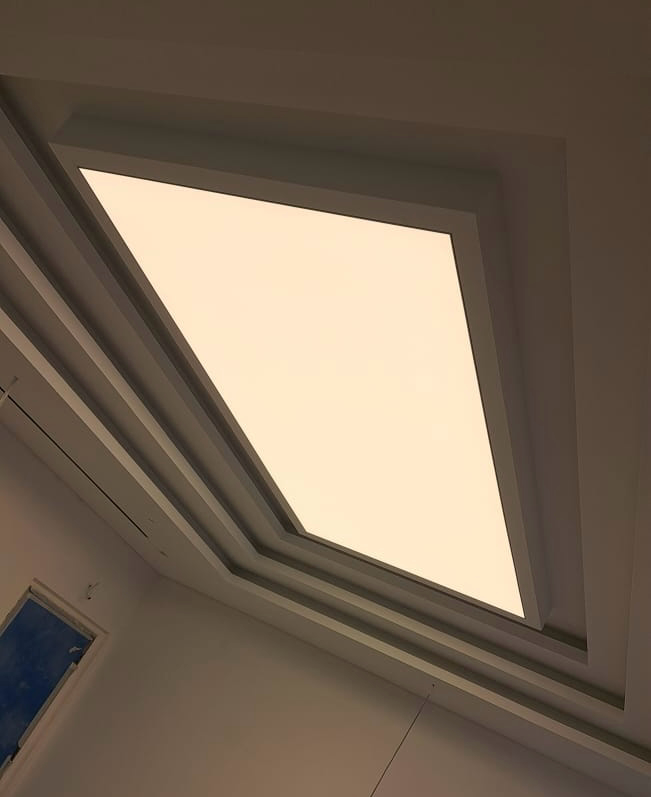
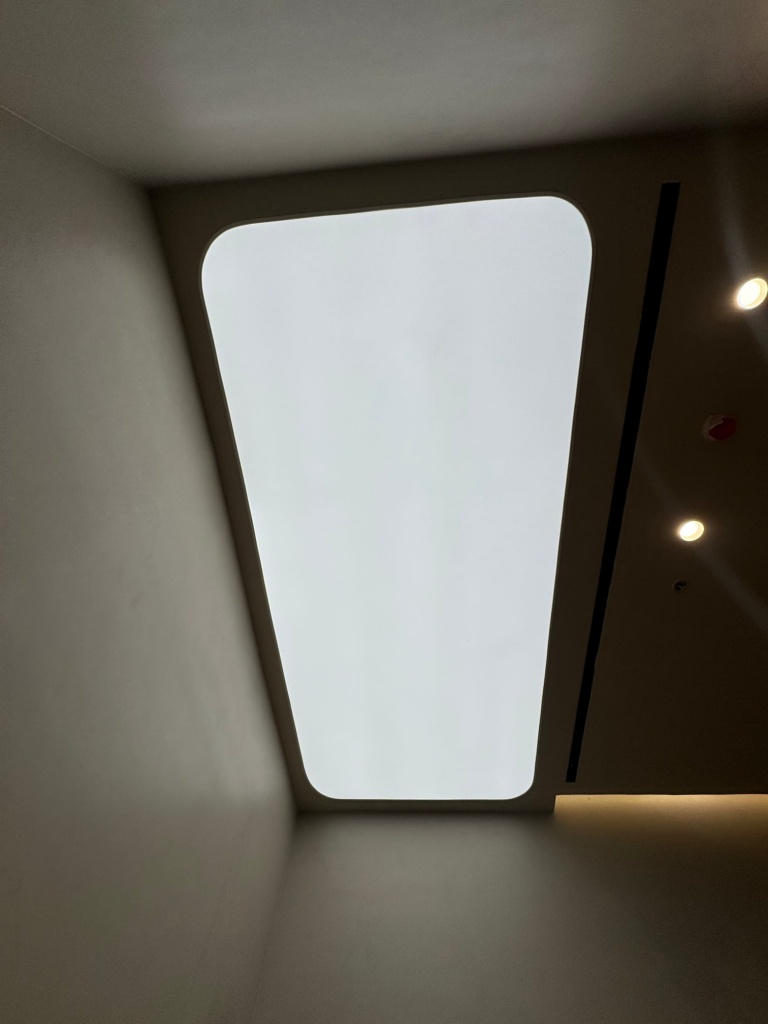
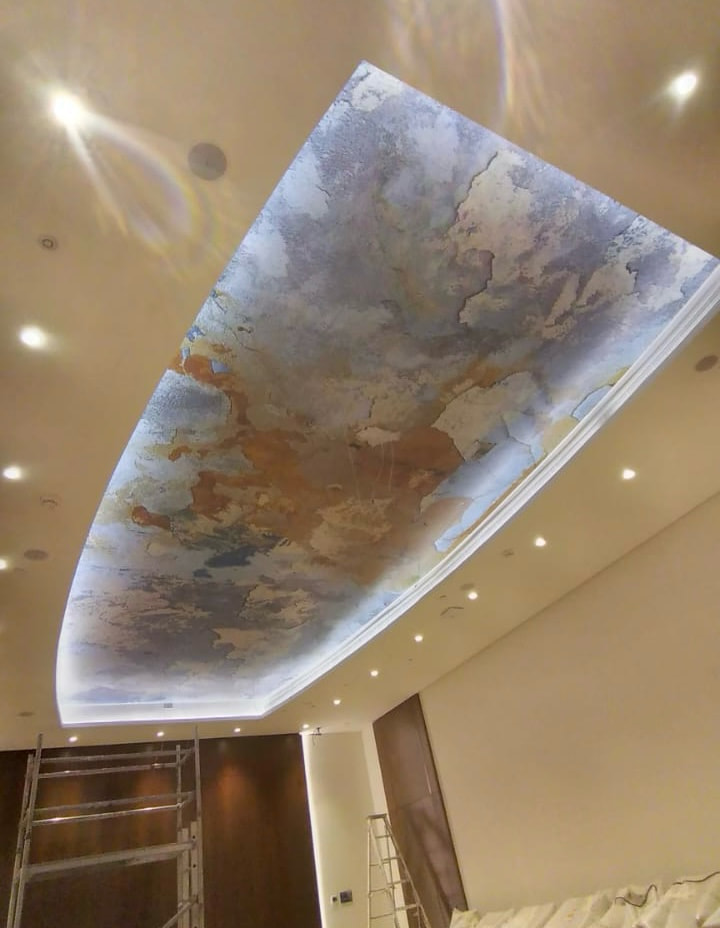
The translucent ceiling installations shown in these project photographs demonstrate one of the most practical differences between the technologies.
LED strips or modules are positioned behind a translucent membrane.
Instead of seeing individual LEDs, the membrane diffuses the light across the entire surface.
The result is a large, clean luminous feature.
Translucent stretch ceilings can be designed as:
rectangular light panels, rounded rectangles, circles, ovals, continuous luminous ceilings or completely custom shapes.
They can be used in corridors, bathrooms, reception areas, offices, retail spaces and residential interiors.
Creating the same seamless luminous surface using conventional drywall alone would require a completely different lighting construction.
Designing a professional light ceiling requires more than simply installing LEDs behind a membrane.
Several factors determine the final uniformity:
LED spacing, distance between the LEDs and membrane, membrane transmission, internal reflection and the geometry of the light box.
If these elements are calculated correctly, the individual LEDs disappear visually.
Instead, the entire ceiling becomes a soft luminous surface.
This is one of the reasons translucent stretch ceilings are increasingly used as an architectural lighting solution rather than simply as a decorative ceiling finish.
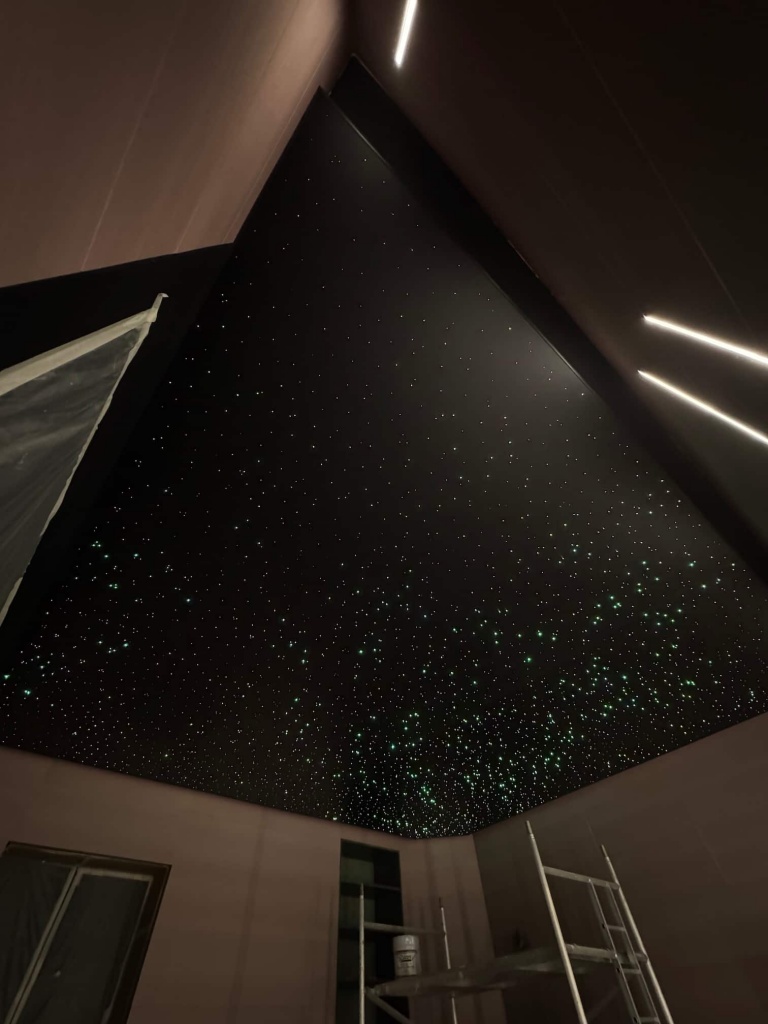
Another major difference can be seen in the fiber optic ceiling projects shown in the photographs.
Hundreds or even thousands of optical fibers can be integrated into a stretch membrane to create individual points of light.
The effect can range from a subtle star field to an extremely dense galaxy ceiling.
Different fiber diameters can be combined to create variation in the apparent size and brightness of the stars.
Depending on the light engine and control system, the installation can also include twinkling effects, dynamic sequences or color-changing effects.
This transforms the ceiling into a decorative lighting feature.
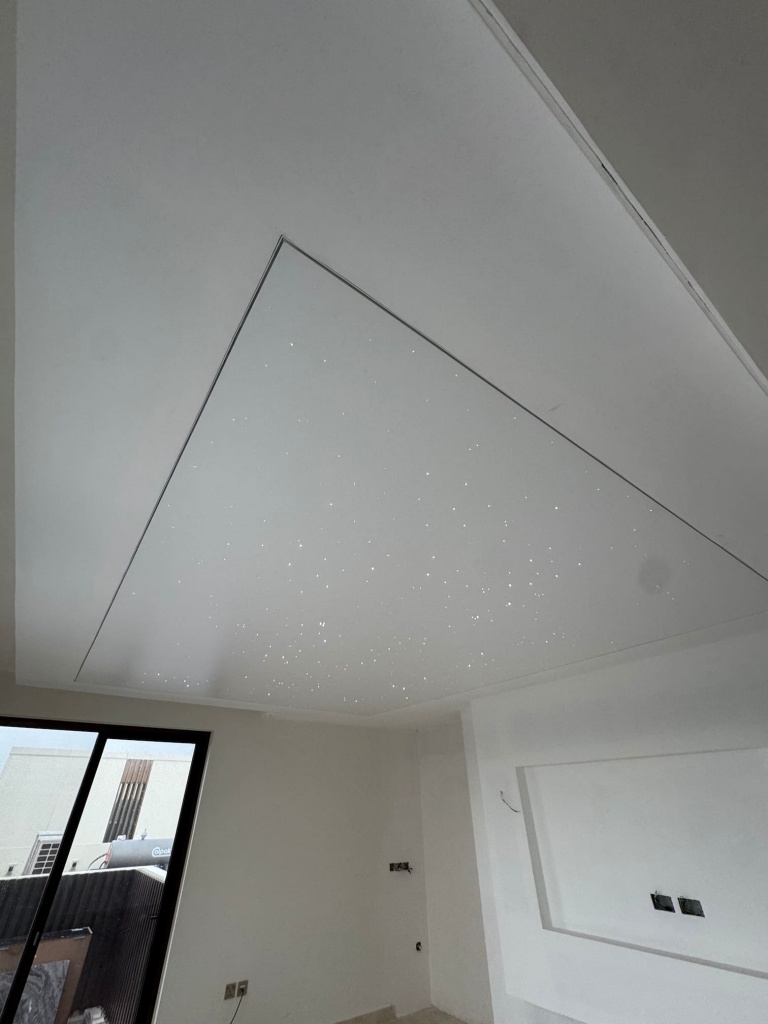
One of the photographs shows a white stretch ceiling with integrated fiber optic stars.
This is an interesting alternative to the traditional black star ceiling.
During the day, the white membrane remains visually minimal and integrates naturally into a contemporary interior.
When the fiber optic system is switched on, hundreds of small points of light become visible across the ceiling.
This allows a designer to introduce a star ceiling without making the room visually dark.
White fiber optic ceilings can work particularly well in bedrooms, children’s rooms, spas and luxury residential interiors.
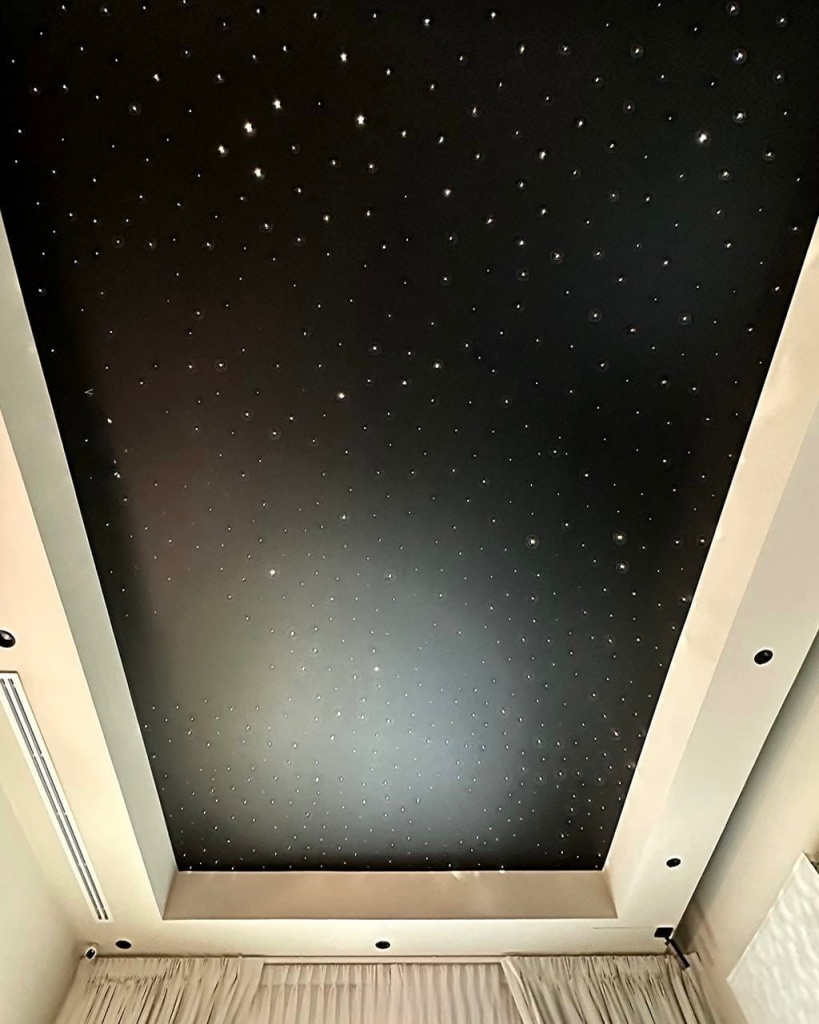
The large black ceiling shown in another photograph demonstrates the opposite approach.
Here, the dark membrane creates maximum contrast with the illuminated fibers.
Hundreds of stars appear against the black background, producing a much stronger night-sky effect.
A black fiber optic stretch ceiling is particularly suitable for:
home cinemas, gaming rooms, bedrooms, lounges, entertainment areas and other spaces where the ceiling is intended to become a dramatic feature.
The density and distribution of stars can be customized for each project.
Stretch ceiling technology is not limited to flat surfaces.
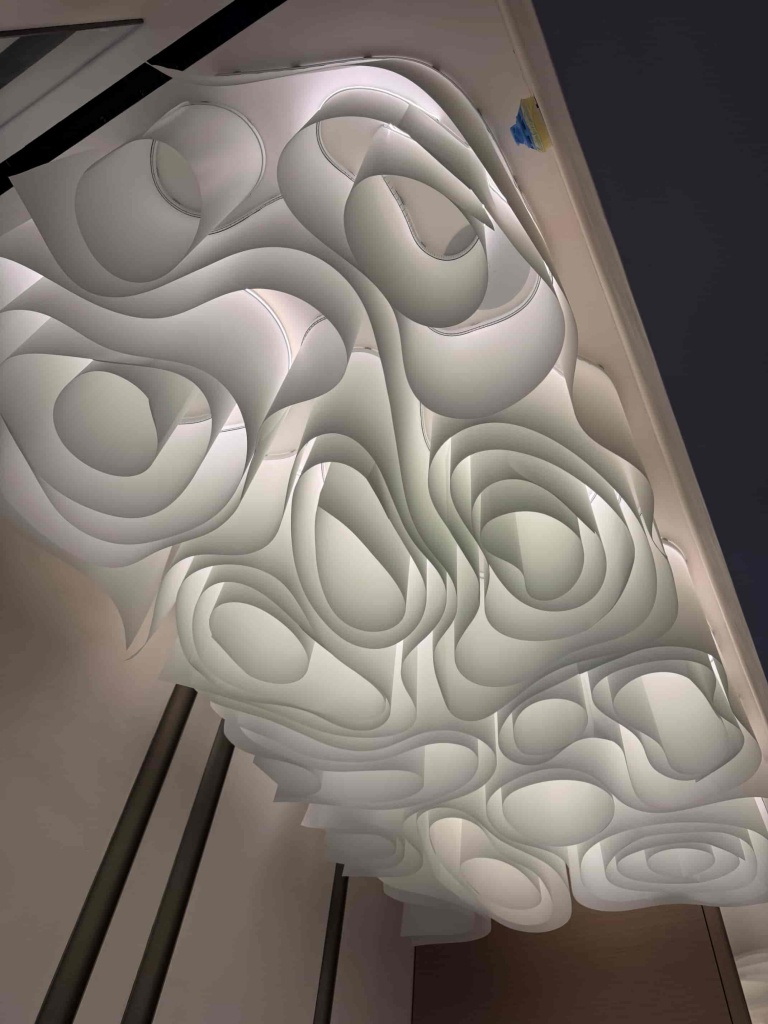
The third photograph demonstrates a completely different application: a 3D sculptural ceiling created using curved membrane elements.
The material forms multiple flowing shapes across the ceiling while integrated lighting emphasizes the curves and depth of the composition.
Instead of treating the ceiling simply as a flat surface, it becomes a three-dimensional architectural installation.
These solutions can be created for luxury villas, hotel interiors, restaurants, retail spaces, reception areas and feature corridors.
Drywall can also be used to create curved structures, but the construction method and resulting geometry are fundamentally different.
For conventional ceiling architecture, drywall remains extremely versatile.
But stretch ceiling systems significantly expand the range of available finishes and lighting effects.
A stretch ceiling can become a simple matt surface, a mirror-like glossy feature, an illuminated panel, a star field or a three-dimensional installation.
It can also be produced in circles, ovals, rectangles, rounded shapes and custom geometries.
This flexibility is particularly valuable when architects and interior designers want the ceiling to become an important part of the overall design concept.
Stretch Ceiling and Drywall Together
In many projects, choosing between stretch ceiling vs drywall is actually unnecessary.
The two technologies can work together.
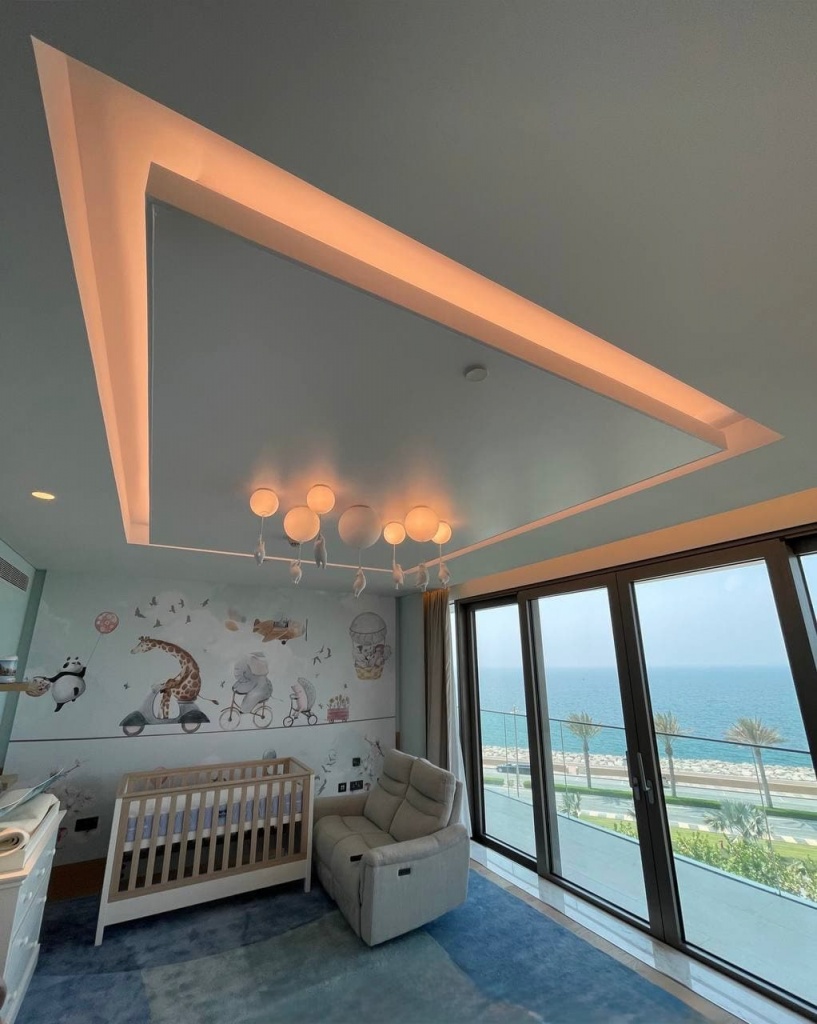
Drywall can create the primary architectural structure, while stretch ceiling technology creates the finished decorative or illuminated section.
For example, a drywall perimeter can surround a large translucent light ceiling.
A recessed drywall feature can contain a glossy stretch ceiling.
A conventional drywall ceiling can transition into a dedicated fiber optic star ceiling.
Drywall bulkheads can also conceal HVAC and other MEP services while the central stretch ceiling creates a clean decorative surface.
This combination gives designers the advantages of both systems.
Cracks and Surface Quality
Drywall ceilings consist of individual boards that must be joined and finished.
Correct installation is extremely important, but building or framing movement can sometimes contribute to visible cracks around joints and transitions.
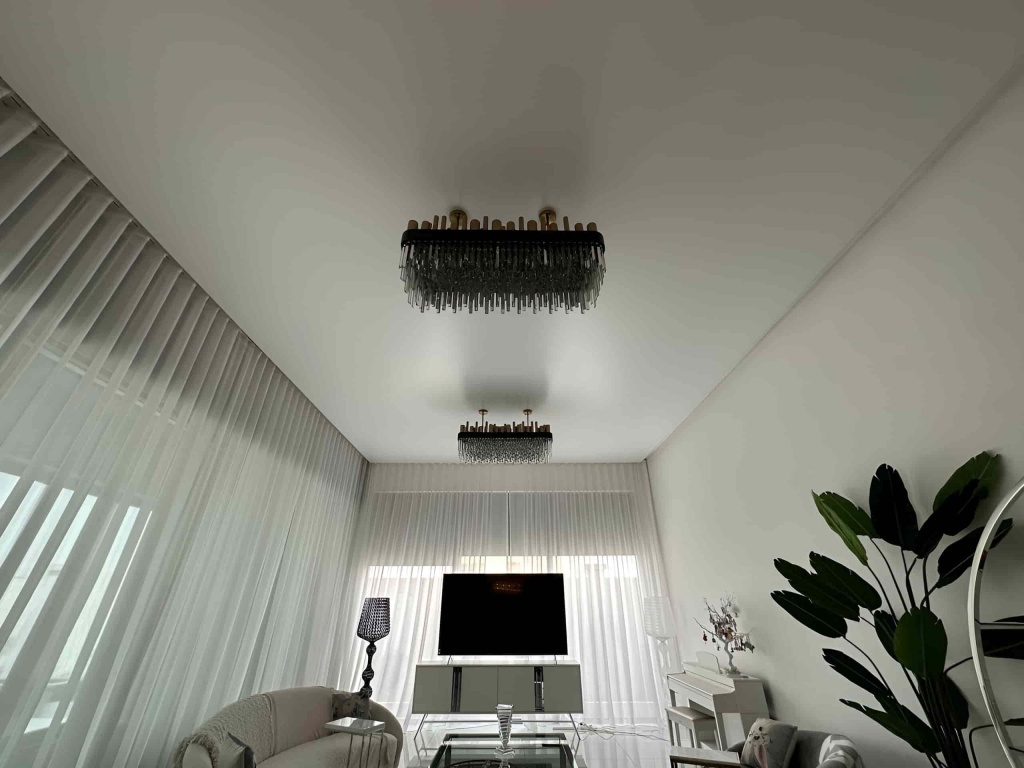
A stretch ceiling membrane behaves differently because the visible surface is flexible and tensioned.
There are no plastered board joints across the membrane itself.
However, stretch ceilings have their own considerations. The membrane should be protected from sharp objects and installed by trained specialists.
Neither technology is indestructible, but their maintenance characteristics are very different.
The performance of any ceiling in humid environments depends on the materials specified.
Different types of gypsum board provide different levels of moisture resistance.
Stretch ceiling membranes also have different technical characteristics depending on the material and manufacturer.
PVC stretch ceiling systems are commonly used where resistance to humidity and easy surface maintenance are important.
For bathrooms, kitchens, swimming pool areas and other demanding spaces, the complete system should be selected according to the actual environmental conditions.
This includes the membrane, profiles, lighting components, electrical equipment and fixings.
Modern ceilings often conceal significant technical infrastructure.
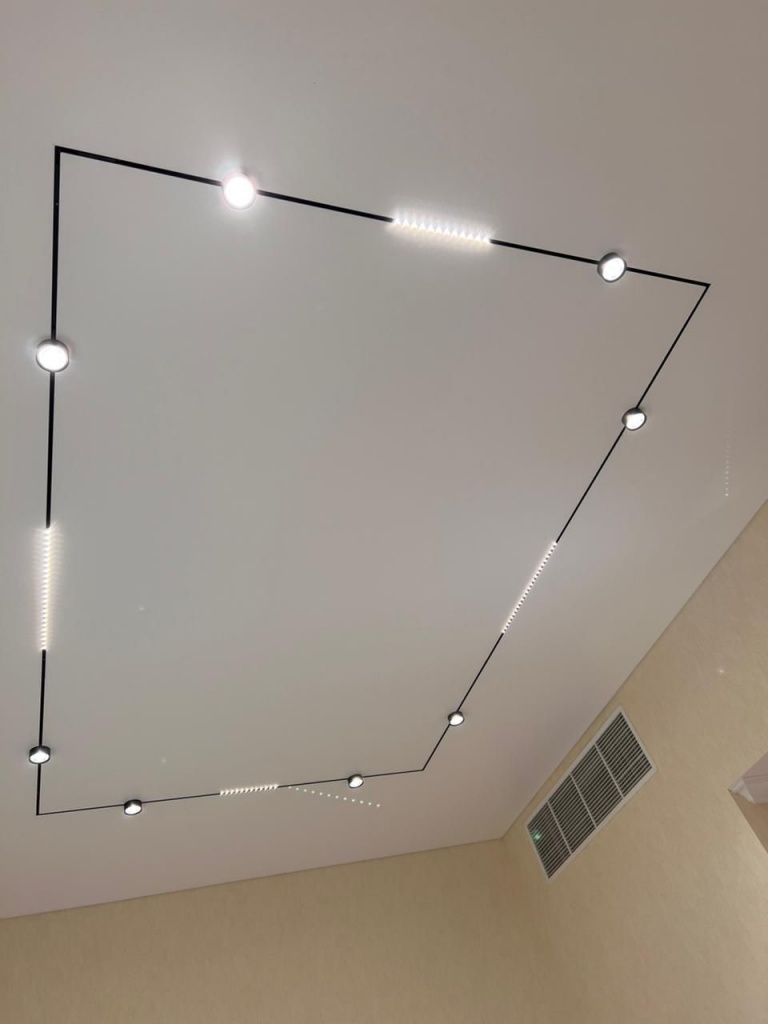
Above the ceiling there may be LED drivers, electrical cables, HVAC components, speakers, lighting controls and other equipment.
With drywall, access is normally provided through dedicated access panels.
Stretch ceiling systems can also be designed to provide access to selected technical areas, and some membrane installations can be partially removed and reinstalled by specialists when maintenance is required.
Access requirements should therefore be coordinated before either ceiling system is installed.
It is difficult to say that one system is always cheaper than the other.
A basic matt stretch ceiling cannot be compared directly with a complex multi-level drywall ceiling.
Similarly, a simple painted drywall ceiling cannot be compared with a high-density fiber optic star ceiling or a large backlit translucent ceiling.
The final cost depends on the ceiling area, geometry, height, profiles, membrane finish, drywall complexity, lighting system, MEP integration and access requirements.
For illuminated ceilings, LED quantity, drivers and control systems must also be considered.
For fiber optic ceilings, the number of fibers, fiber density, light engine and required effects influence the price.
The correct comparison is therefore not simply price per square metre.
It is the cost of achieving the required architectural and lighting result.
Which Ceiling Is Better for Renovation?
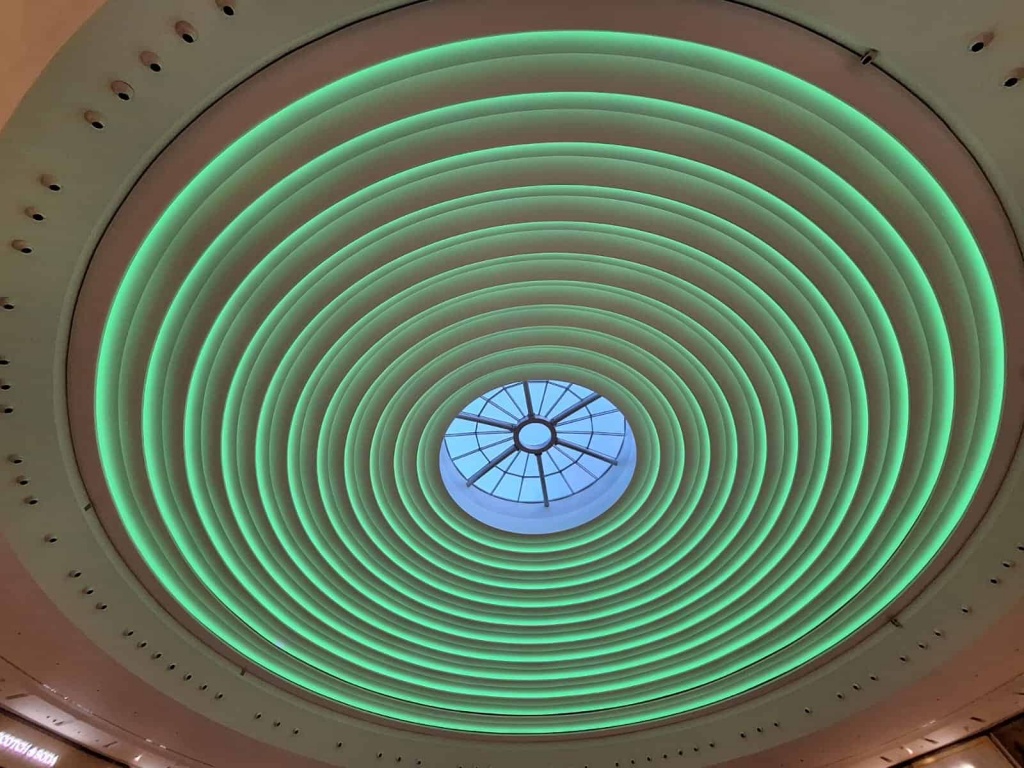
Stretch ceilings can be particularly useful for renovation because a new finished surface can often be installed below an existing ceiling, subject to available space and site conditions.
This can reduce the amount of traditional surface preparation required.
Drywall remains the better construction method when the renovation requires new bulkheads, major architectural forms or substantial enclosures for building services.
For more complex renovations, the two systems can again be combined.
Which Ceiling Is Better for a Luxury Villa?
Luxury villas rarely require only one type of ceiling throughout the entire property.
Different rooms have different requirements.
A living room may use drywall architecture combined with a glossy decorative stretch ceiling.
A corridor may feature a translucent light ceiling.
A bedroom may use a white fiber optic ceiling.
A home cinema may use a black star ceiling.
Another area may use a sculptural 3D membrane installation.
This is why stretch ceiling technology should not necessarily be considered a direct replacement for drywall.
It is another architectural tool that allows designers to create ceiling solutions that would be difficult to achieve using conventional construction alone.
Stretch Ceiling vs Drywall in Dubai
Ceiling projects in Dubai frequently involve extensive integration with other building systems.
The ceiling may need to accommodate air-conditioning diffusers, sprinklers, smoke detectors, speakers, downlights, chandeliers, access panels and automation equipment.
All of these components must be coordinated with the ceiling design.
PIONER GROUP provides custom stretch ceiling solutions for residential and commercial projects in Dubai and across the UAE, including integration with existing or newly constructed drywall ceilings.
Our systems can include matt and glossy membranes, translucent light ceilings, fiber optic star ceilings and custom decorative ceiling features.
Stretch Ceiling vs Drywall – Which Should You Choose?
For a conventional architectural ceiling with bulkheads, recesses and standard lighting, drywall can be an excellent solution.
When the priority is a perfectly smooth finished surface, large luminous ceiling, glossy effect, fiber optic star field or custom membrane feature, stretch ceiling provides significantly more design possibilities.
For many premium interiors, however, the best solution is not one or the other.
It is:
Drywall for architectural construction + stretch ceiling for the decorative surface, lighting feature or special effect.
This allows architects and interior designers to use the strengths of both technologies within the same project.
FAQ – Stretch Ceiling vs Drywall
Is stretch ceiling better than drywall?
It depends on the application. Drywall is excellent for constructing solid architectural ceiling elements, while stretch ceiling offers more options for special finishes, illuminated surfaces, glossy ceilings and fiber optic effects.
Which ceiling has a smoother finish?
A correctly installed stretch membrane provides a highly uniform finished surface without plastered board joints. The quality of a drywall surface depends on installation and finishing.
Does a stretch ceiling require painting?
No. The membrane itself provides the finished surface.
Can stretch ceiling be combined with drywall?
Yes. This is one of the most common approaches for sophisticated ceiling designs. Drywall creates the surrounding architecture while the stretch ceiling forms the decorative or illuminated section.
Can you install LED lighting behind a stretch ceiling?
Yes. A translucent membrane can diffuse LED lighting installed behind it to create a large uniform light ceiling.
Can you create a star ceiling with stretch ceiling?
Yes. Fiber optic strands can be integrated through the membrane to create hundreds or thousands of illuminated stars.
Can stretch ceilings be glossy?
Yes. High-gloss membranes can create a highly reflective, almost mirror-like ceiling surface.
Is stretch ceiling suitable for Dubai villas?
Yes. Stretch ceiling systems can be used in villas, apartments and commercial interiors, provided the correct membrane and system are specified for the particular application.
Choosing Between Stretch Ceiling and Drywall?
PIONER GROUP designs and installs bespoke stretch ceiling systems for luxury villas, apartments, hospitality spaces, retail interiors, offices, and premium projects across Dubai and the UAE.
- ✅ Matt, satin, and glossy stretch ceilings
- ✅ Translucent LED light ceilings
- ✅ Fiber optic star and galaxy ceilings
- ✅ White and black star ceiling systems
- ✅ 3D and sculptural ceiling features
- ✅ Integration with drywall and architectural ceiling systems
- ✅ Complete design, supply, and installation
Phone: +971 56 896 8934
Email: info@pioner-group.com
Send us your room dimensions, ceiling drawings, PDF/DWG files, lighting requirements, or inspiration images. Our team will review your project and recommend whether stretch ceiling, drywall, or a combination of both is the most suitable solution.